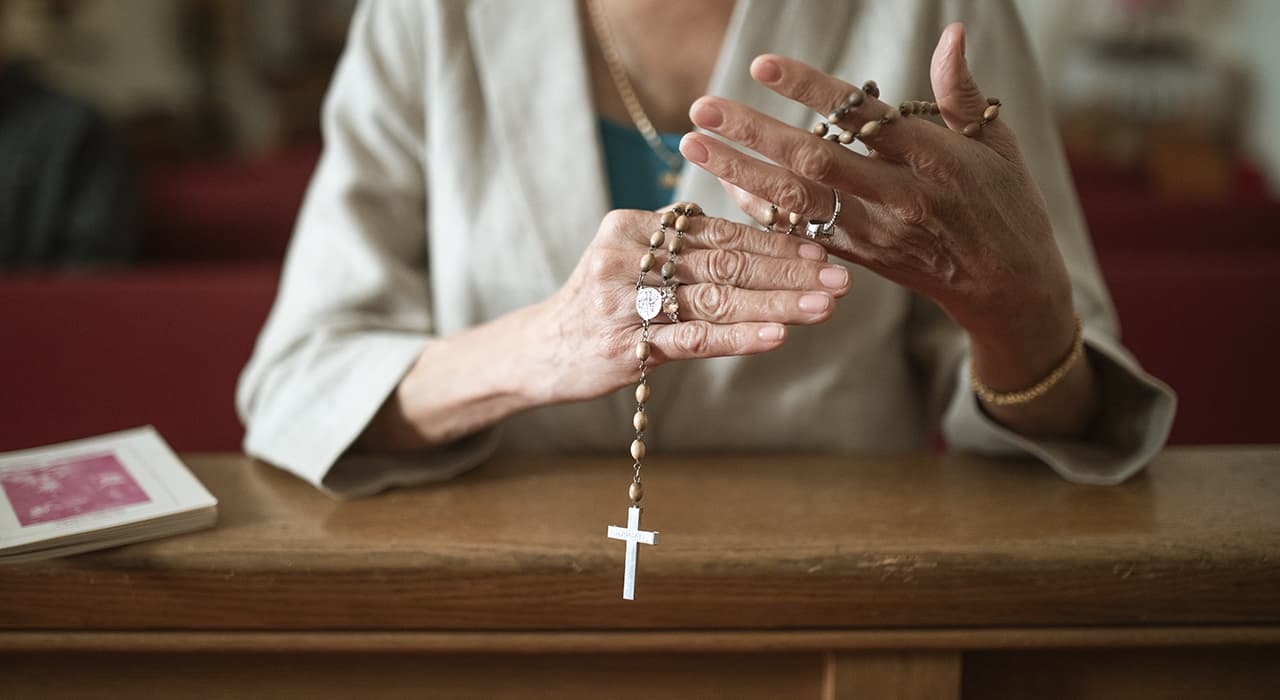
I was raised a Catholic. My dad has always been Catholic, and my mom converted to Catholicism when she was a teenager. After her mother (my grandmother) died in an automobile accident, she became a nun and lived in a convent. It was while my mom was a nun that she met my dad. Both of them sang in the church choir and, well, that was that.
My family was fairly devout: we always went to church every Sunday, and us kids attended the Catholic catechism classes on Monday afternoons. I even became an altar boy for a few years.
I was probably introduced to Islam in the ninth grade, in my social studies class. I remember remarking to a classmate that if I ever left the Catholic Church, I’d become a Muslim. What fateful words.
As I grew older, I became enamored with science, particularly astronomy. Even today, I still love reading about science, but back then, I began to think that there was no God. (Allah have mercy on me for thinking such terrible thoughts.) For quite some time, I considered myself an atheist, but I always had this fascination with religion. I continued to read about different religions, Zen Buddhism in particular.
In 1982, I met two guys who were Unitarians. For those who don’t know about the Unitarian Universalist Church, the church is an offshoot of Christianity. The primary difference between the Unitarian Church and other protestant sects is that Unitarians reject the trinity. (The joke is that Unitarians believe in, at most, one God.) Back then, I couldn’t accept Jesus (PBUH) as the Son of God, although I could accept him as a prophet. For some reason, atheists are accepted into the Unitarian Church, so I became a member. Even today, I think well of the Unitarian Church. While Islam is a much stricter and more conservative religion than the Unitarian Church, I think the two faiths share much in common.
In 1985, I began attending Arizona State University. Needing to take some humanities classes for my degree, I thought that a course entitled “Islamic Civilization” looked interesting. The course was taught by a pair of professors, one who was from the religious studies department, and another who was in the history department. I found the course to be quite interesting, with the highlight being a field trip to the Islamic Cultural Center of Tempe, just a few blocks away from the university. The ICC of Tempe is a beautiful facility, being a replica of “Dome of the Rock” in Jerusalem. (Ironically, this course was brought up in one of my job interviews. In 1991, I had an interview with the Central Intelligence Agency (CIA) for some administrative position. I was expecting the interviewer to ask me business questions (I was finishing up work on my M.B.A. degree), but he was very curious about what “Islamic Civilization” covered and why I had taken the class. Don’t worry, though, I’ve never had any more contact with the CIA. ;) )
Soon after, I purchased a copy of the Qur’an (the N.J. Dawood translation, published by Penguin). I read some of the Qur’an, but not much. Still, between the “Islamic Civilization” course and my small knowledge of the Qur’an, I was ready for the next phase of my life.
In the mid 90s, I met a young woman named Delena. Delena was as blonde as she was beautiful, and we used to talk for hours over the phone. I eventually asked her out on a date, but due to unforeseen problems, the date didn’t go as planned. However, the night we were supposed to go out, Delena invited me over to her apartment where we had some pizza and watched a few videos. During a break between videos, I walked about her apartment and discovered a Muslim calendar on her wall. “What’s this?” I asked. It turned out that she had become a Muslim a few years earlier. The rest of that night was spent talking about Islam, as were quite a few of our telephone conversations afterwards. (Unfortunately, Delena and I didn’t work out as a couple which is really too bad because I’m still in love with her. Delena, if you ever read this, I would marry you in an instant if you’re still available.)
In my conversations with Delena, I would find that I had problems with the Dawood translation. Dissatisfied, I bought another translation of the Qur’an, that of Mohammed Marmaduke Pickthall. It was this translation where the words of Allah really began to strike a chord in my heart. I became much more serious about reading the Qur’an, and I have read most of the way through the book now. However, I still didn’t decide to convert yet. One of my “problems” was that I was still the scientific skeptic. I wanted some sort of proof that the Qur’an was truly the word of Allah.
A few months ago, I found another version of the Qur’an for sale, this time the Ahmed Ali translation. I bought this one and began reading through it, in part because I was curious to see how this translation differed from the Pickthall translation. In Sura 16, “The Bees,” there is the following verse (15):
“He placed
stabilizers in the earth
so that while
it revolves you live undisturbed,
and rivers
and tracks
so that you
may find your way;”
In one of Ali’s few commentaries in this edition, he writes (in part) about this verse:
“Stabilisers, rawasi, are actually mountains in the interior of the earth made evident by modern geophysicists who mapped the earth’s interior. At some places they are 6 miles high and 6000 miles wide with a valley as deep and wide, situated between the liquid core and the crust of the earth. Their function is to stabilize the crust and rotation of the earth…This description would apply to underground ‘stabilisers’ when used with ‘so that while it revolves you live undisturbed,’ as here and in 21:31, 3:10, and also 77:27. In 13:3, 15:19, 27:61, 50:7 on the other hand, it has been used for mountains as stabilizers.”
Now this was the sort of rational proof that I could accept. How could Muhammad (PBUH) possibly know about “stabilisers” that Allah had placed in the earth? Geological structures of this magnitude could not possibly have been known about until the advent of seismological instrumentation. This was the sort of proof I had been looking for to confirm that the Qur’an was Muhammad’s continuing miracle, the true word of God.
The thought occurred to me recently that here I was, the owner of three translations of the Qur’an, and yet I had never said the Shahadah in public. Yet, if I were to die in an accident, people would believe that I was a Muslim (due to three Qur’ans and other books on Islam in my apartment). I decided then to say the Shahadah. I went down to the ICC of Tempe, and immediately got a case of “cold feet.” I wandered outside for at least ten minutes debating whether I should walk inside. Finally, I decided to walk away. The thought came to me that I was being a coward. That stung. I didn’t want to think of myself as being scared to say the Shahadah. I immediately turned around and went inside. Much to my surprise, there was no one there. Eventually, a black man named Hakim asked if I needed any help. Still fearful of really becoming a Muslim, I asked if there was an application form I could fill out for joining the Masjid. I will forever remember Hakim’s reply: “This ain’t no club, man.” “Yes, I know that,” I thought to myself. Eventually, he asked if I wanted to say the Shahadah, and I said yes. So in the presence of Hakim and an Arab gentleman, I stumbled my way through unfamiliar Arabic words. I feel badly that I said it so poorly, so now I will say again what has become increasingly familiar:
Ashhadu an la ilaha illa Allah wahda-hu la sharika la-h wa ashhadu anna Muhammadan ‘abdu-hu wa rasulu-h.
It has been a long and winding road to Islam for me. I would like to thank two people for guiding me on this path: Delena, who was my catalyst in starting to read the Qur’an seriously, and Fareena, who runs the website, Islam – The Modern Religion. In the past few years, I have visited many websites on Islam, but I like Fareena’s the best. It is highly informative and has helped me greatly in learning about my new religion. Thank you to both of these special women in my life.
|
|