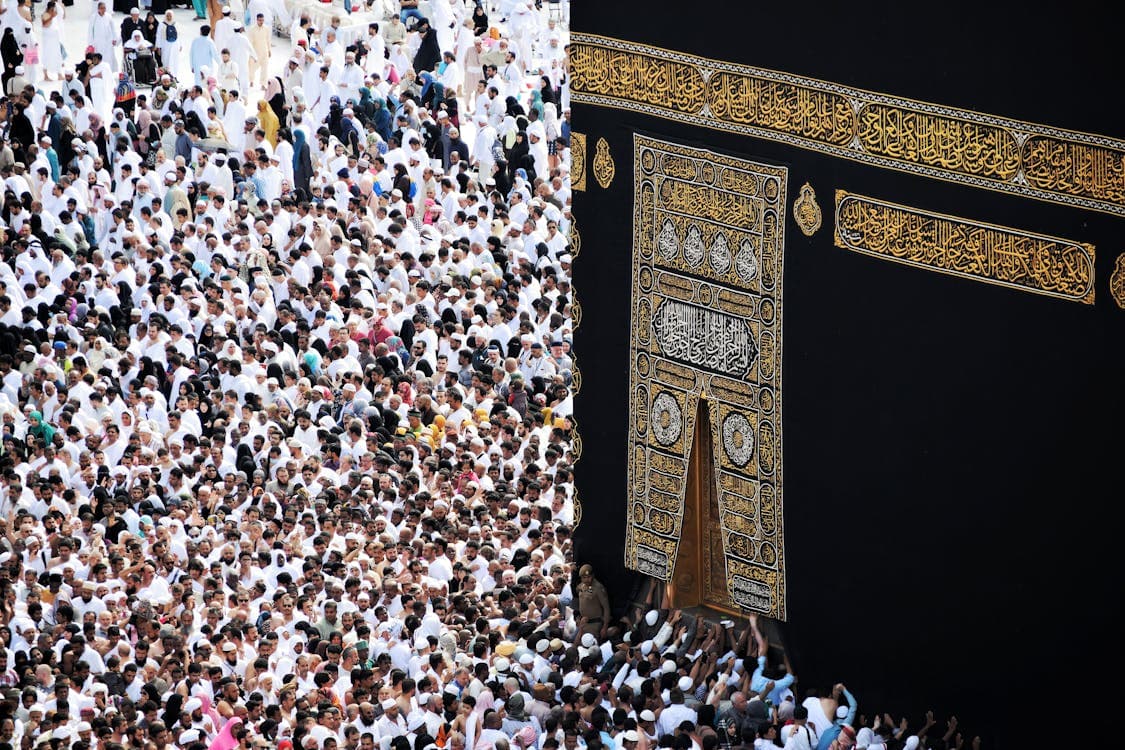
To understand a religion fully, it helps to understand the landscape that shaped it. Christianity is easier to read in the hill country of Galilee than in a European cathedral. Buddhism makes a different kind of sense in the foothills of the Himalayas than in a Western convert’s meditation centre. And Islam, which emerged in the desert landscape of the Arabian Peninsula in the 7th century CE, carries within its practice, its architecture, its social ethics, and its cosmology the imprint of that origin environment in ways that remain legible today.
The Wahiba Sands, known in Arabic as Ramlat al Wahiba, cover roughly 12,500 square kilometres of the eastern Arabian Peninsula in the Sultanate of Oman. The dune field runs from the Hajar Mountains in the north to the Arabian Sea in the south, reaching heights of over 100 metres in places and supporting a Bedouin population that has lived in and around the sands for centuries. Spending time here, sleeping in the desert, watching the call to prayer orient the day, and sitting with Bedouin guides whose cultural memory of this terrain runs deep, produces an understanding of the desert roots of Islamic practice that no amount of reading quite reaches. Here are eight reasons why.
1. The Desert Context Explains Islamic Theology’s Emphasis on Unity and Submission
The Arabic word Islam means submission, specifically submission to the will of God, and the theological emphasis on tawhid, the absolute oneness and unity of the divine, makes a different kind of intuitive sense in a desert landscape than it does in a city. In the Wahiba Sands, the horizon is unbroken in every direction. There are no competing reference points, no architectural complexity, no layered visual environment. There is the sky, the sand, and the light that moves across both. The simplicity is not emptiness. It is a forceful absence of everything that is not fundamental.
Early Islamic theology developed in a context where this kind of radical simplicity was a daily environmental fact for a significant portion of the community. The call to strip away polytheism and acknowledge a single, indivisible divine reality resonated with people who lived in a landscape that already stripped away everything except the essential. The desert did not cause Islamic theology. But it prepared the ground for it in ways that are still perceptible when you stand in the Wahiba Sands at dawn.
2. Bedouin Hospitality Is the Living Form of the Islamic Ethics of the Guest
One of the most consistent ethical emphases across the Quran and the Hadith is the treatment of the guest. The obligation to feed, shelter, and protect a visitor regardless of tribe, status, or prior relationship is not a peripheral cultural practice in Islamic ethics. It is a central one, rooted in the desert reality that a traveler without shelter and water in the Arabian Peninsula was in mortal danger, and that a community that turned away travelers was a community that would eventually turn away from God.
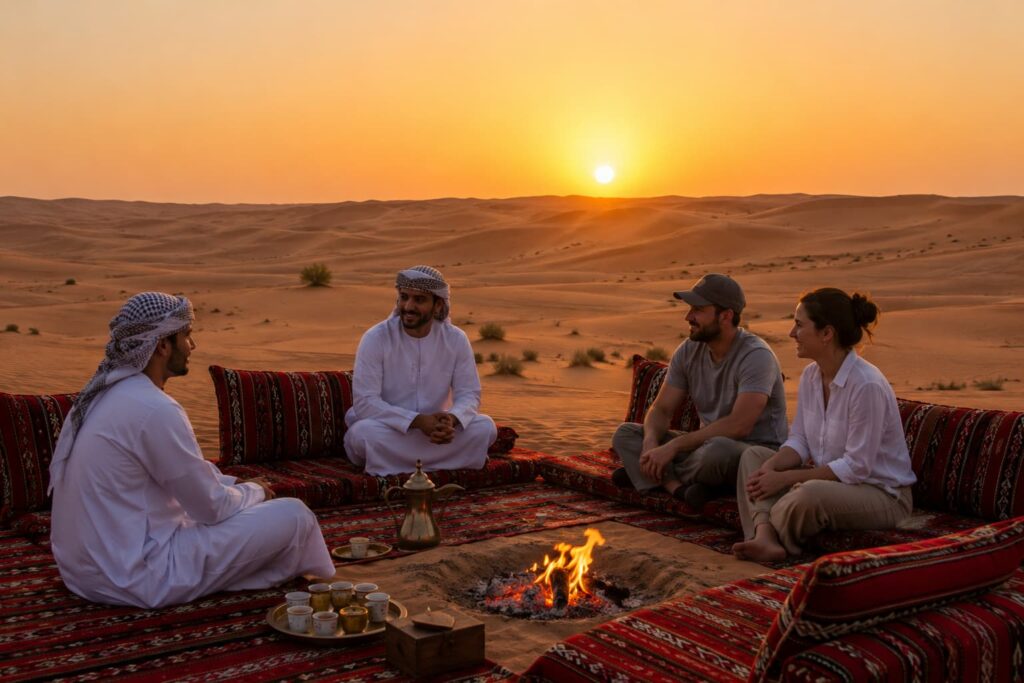
This ethic is still operational in the Bedouin communities of the Wahiba Sands. A visitor arriving at a Bedouin camp, known or unknown, is offered coffee, dates, and shelter before any other exchange takes place. The sequence is not hospitality as social performance. It is the material expression of a theological commitment so old that it predates the formal articulation of Islamic law and runs through the culture beneath it. Experiencing this directly, as a guest in a desert camp, gives the Quranic passages on hospitality and the guest a weight that reading them in translation does not produce.
3. Oman’s Ibadi Islam Is One of the Oldest Surviving Branches of the Faith
Most people who study Islam encounter either Sunni or Shia traditions as the primary available frameworks for understanding the religion’s internal diversity. Oman offers a third path that predates the Sunni-Shia split and has preserved its distinct theological character for over thirteen centuries. Ibadi Islam, the majority confession in Oman, emerged from the early Kharijite movement in the first generation after the Prophet’s death and developed its own legal tradition, theological positions, and political philosophy in relative isolation on the eastern edge of the Arabian Peninsula.
Ibadi theology places particular emphasis on the community’s collective responsibility to maintain just governance and to withdraw from unjust rulers, a position that shaped Oman’s political history across multiple centuries and produced a tradition of religious scholarship that is less well-known in the West than it deserves to be. As our overview of Islam as a world religion notes, the faith contains considerable internal diversity that is often obscured by the dominance of Sunni and Shia frameworks in Western scholarship. Oman and its Ibadi tradition offer a corrective that rewards direct encounter.
4. The Five Daily Prayers Take on a Different Character in the Desert
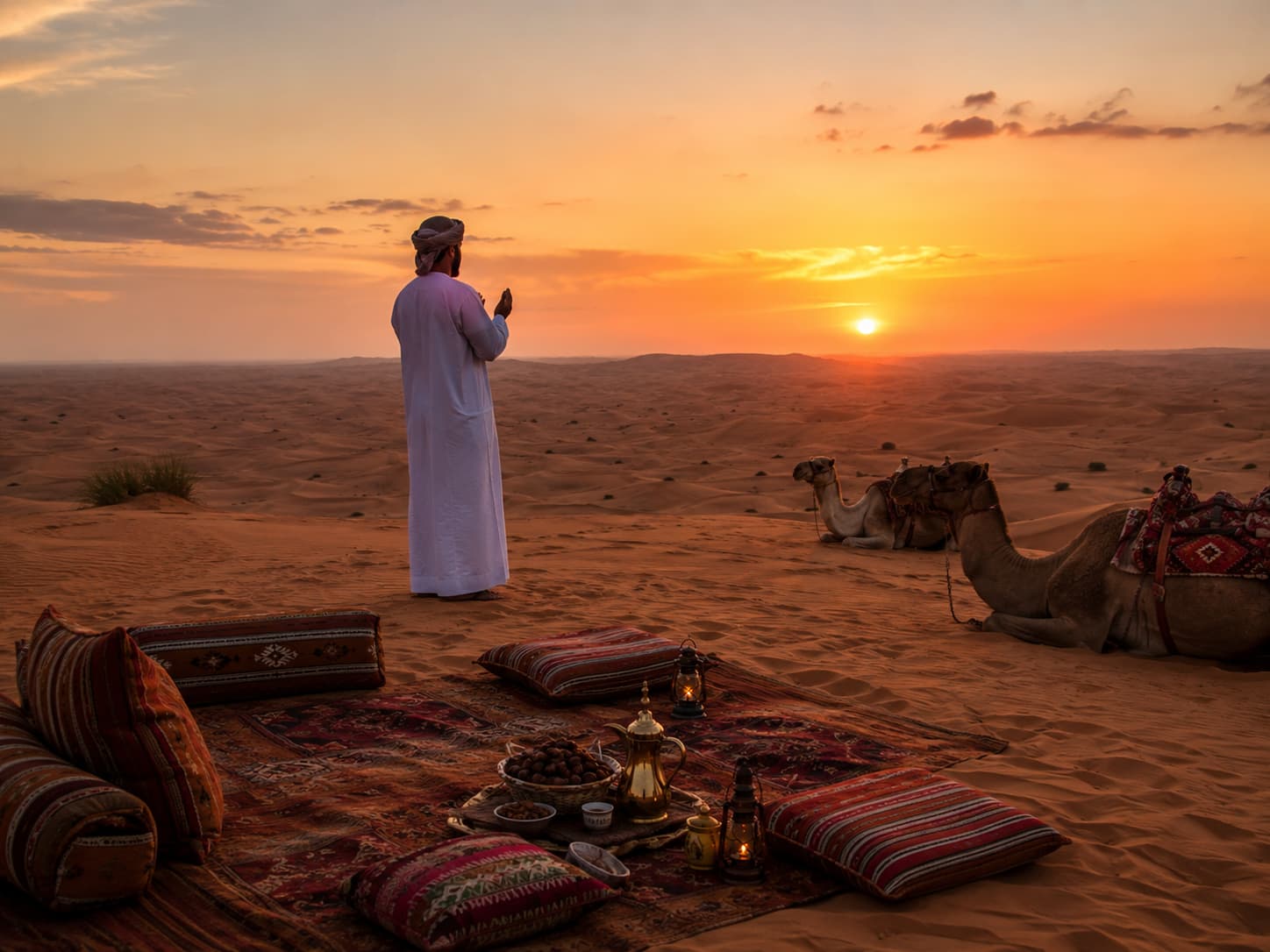
The five daily prayers of Islam, the Salah, are structured around the movement of the sun: Fajr at dawn, Dhuhr at midday, Asr in the afternoon, Maghrib at sunset, and Isha after dark. In a city, these times are marked by the call to prayer broadcast from minarets, a sound that competes with traffic, construction, and the general noise of urban life. In the desert, they are marked by the light itself.
In the Wahiba Sands, where the sky is unobstructed and the light changes are dramatic and total, the prayer times are legible in the landscape without any announcement. Fajr arrives as a grey line on the eastern horizon that becomes pink and then gold over twenty minutes. Maghrib is the moment the sun breaks the dune crest to the west and the temperature drops immediately. The Islamic prayer schedule is a way of attaching religious practice to natural time rather than clock time, and the desert makes this attachment direct and physical in a way that urban practice tends to obscure. Watching a Bedouin guide stop, face Mecca, and pray at Maghrib while the dunes turn orange around him is an experience of the prayer’s logic that a textbook description cannot replicate.
5. The Quran’s Desert Imagery Is Everywhere Visible in the Landscape
The Quran is full of desert imagery: the shade of a single tree as a mercy, water as the source of all living things, the stars as navigation guides, the wind as a divine messenger, the bleached bones of a dead camel as a sign of mortality and resurrection. These images were not metaphors chosen for poetic effect. They were the literal daily environment of the people to whom the text was first addressed, and they retain their force most fully in the landscape that produced them.
Reading Quranic passages about water in a desert context produces a different response than reading them in a climate where water is abundant and unremarkable. The verse that describes God sending down water from the sky to revive dead earth carries a weight in the Wahiba Sands that it simply does not carry in a northern European or North American reading context. For anyone who studies religious texts and wants to understand them in something closer to their original register, spending time in an Arabian desert landscape recalibrates the imagery in ways that are difficult to achieve by other means.
6. Guided Tours Navigate the Sands’ Terrain and Cultural Access
The Wahiba Sands are accessible from the town of Bidiyya in the north or from the coastal road in the south, but navigating the dune terrain independently requires experience with soft-sand driving and local knowledge of which routes are passable in current conditions. The Bedouin communities within the sands are welcoming to respectful visitors but are not organised for independent tourism in ways that make unguided cultural access straightforward.
Operators like Wahiba Sands Tours offer structured desert experiences that include dune driving, camel trekking, Bedouin camp visits, and overnight stays in the sands, with guides who speak Arabic and have relationships with the local communities that make the cultural encounters described above available rather than incidental. For visitors whose interest in the Wahiba Sands extends to the religious and cultural dimensions rather than just the landscape, having that community access and linguistic mediation is the difference between witnessing and understanding.
7. Oman’s Religious Tolerance Is a Distinctive Feature of Its Islamic Identity
Oman has maintained a tradition of religious tolerance that is rooted in its Ibadi theological framework and its long history as a maritime trading nation with connections to East Africa, South Asia, and Persia. The country has historically accommodated Hindu, Christian, and Jewish communities within its borders, and the late Sultan Qaboos, who ruled from 1970 to 2020, made religious tolerance an explicit element of national policy during a period of significant regional sectarian tension.
This tolerance is not secular indifference to religion. It is a specific Islamic position, derived from Ibadi jurisprudence and the practical ethics of a trading society that understood the value of peaceful coexistence across faiths. The peculiarities of Islam as a faith include its formal provisions for the protection of other monotheistic communities, and Oman’s history demonstrates what those provisions look like when they are applied consistently across centuries. Visiting the country and speaking with Omani Muslims about their understanding of their own tradition produces a picture of Islamic social ethics that is more varied and more interesting than most Western media coverage of the religion suggests.
8. The Starfield Above the Wahiba Sands Is the Sky the Quran Describes
Light pollution is absent from the Wahiba Sands in a way that most people who live in or near cities have never experienced. On a moonless night, the Milky Way is not a faint smear but a structural feature of the sky, dense and textured and bright enough to cast a shadow. Individual stars are not points but small discs. The movement of the sky across the night is visible to the naked eye in a way that reconnects the observer to the navigational and cosmological function of the stars that runs through Islamic tradition.
The early Muslims were desert people who navigated by stars, oriented their prayers by celestial bodies, and understood the ordered movement of the sky as one of the primary signs of divine intelligence and design. Islamic astronomy, which preserved and extended Greek astronomical knowledge through the medieval period and contributed foundational work to the development of modern observational science, grew from this tradition of careful sky observation in dark-sky environments. Lying on a dune in the Wahiba Sands and watching the constellations track west across the night gives you the sensory foundation for that tradition in a way that no planetarium can replicate. The sky the Quran describes, ordered, vast, and full of signs for those who reflect, is the sky above the Wahiba Sands. Go on a new moon night and look up.
A Final Thought
Every major religious tradition is easier to understand in the landscape that shaped it. The desert that produced Islam is not a uniform environment. It varies across the Arabian Peninsula in its terrain, its climate, its population, and its cultural traditions. But the Wahiba Sands of Oman offer one of the most accessible, well-preserved, and culturally rich windows into that landscape that remains available to a traveler today.
The dunes, the Bedouin hospitality, the Ibadi mosques, the prayer times marked by desert light, the starfield overhead: each of these is a layer of the same material that the Quran was revealed into and that Islamic practice has been shaped by across fourteen centuries. Understanding them in person adds a dimension to the study of Islam that reading alone does not reach.
That is worth the journey to Oman. Go in the cooler months, between October and March. Sleep one night in the sands. The rest of it will take care of itself.